
Projects
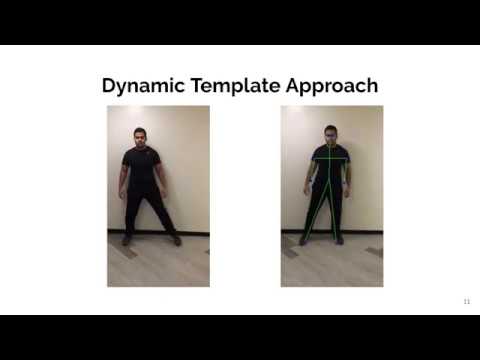
Pose Estimation and Tracking.
Project undertaken as a course project for Introduction to Computer Vision. The goal of this project is to understand current pose estimation methods and compare them with the traditional template based approaches. Also, in our project we focused on Quality over Performance. Current state of the art approaches are very exceptional in performance but not entirely exceptional in quality. We presented an ensemble approach of integrating template based image tracking with deep learning based pose estimation.
Link for the Project Video :
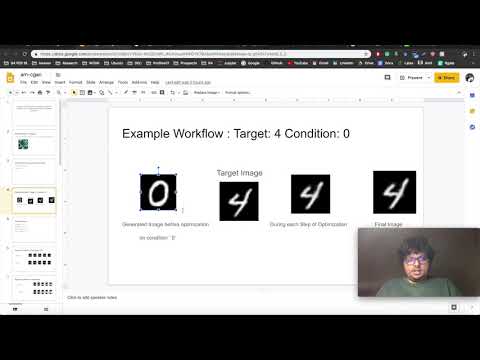
Activation Maximization for Visualization of Feature Evolution on Conditional Generative Adversarial Networks.
Project undertaken as a course project for Deep Learning Foundations from Scratch. As the project has evolved into my masters thesis, the code is private and to be released soon.
Link for the Project Video :
Experiments with Actor Critique Methods for Deep Reinforcement Learning.
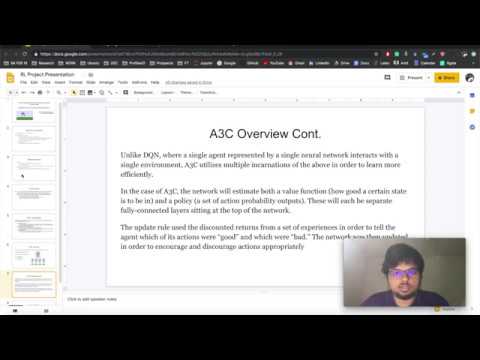
Project undertaken as a course project for Deep Reinforcement Learning from Scratch. We performed a survey on existing approaches for a particular OpenAi gym environment, Bipedial-Walker-V2. Further, We found evidence of actor-critic methods dominating the baseline with a significant benchmark. Our current implementation is built on top of the A3C (Asynchronous Actor Critique) Algorithm.
The project is currently under code review and is to be released and pushed to the OpenAI benchmark page soon.
Link for the Project Video :
Seminar In Statistical Language Modeling Course Project
The course led me to read and summarize 40 selective papers that are popular contributed to Statistical language modeling. As the course project for this course i read and analyzed text to image model and built one from Scratch. This course also gave me a better understanding of the attention mechanism and the behind the scenes workings of transformers.
Link : repo
Natural Language Processing Course Projects
First Project
The first project aims to use NLP methods to identify the presenters, nominees, awards, winners and hosts for a given award ceremony. Overall goal of our project was generalizing the strategies so that they will be applicable to any other award ceremony besides the Golden Globes. Although this model is only trained or build on tweets for the Golden Globes we are sure that it will also perform good on other award ceremonies.Second Project
The second project aims to convert a recipe from AllRecipes.com into another recipe with a different style or cuisine. We parse the HTML code into an internal representation using semantic NLP techniques.
Google Analytics Revenue Prediction
This project is our contribution to a live Kaggle competition by Google. Google gave the task to predict the total revenue generated per customer based on the customer dataset of a Google Analytics Merchandise Store. In short, we have tackled a regression task
Link to project website : webpage
S-LSTM-GAN: Shared Recurrent Neural Networks with Adversarial Training
This is my Bachelors Project, We tried to create a novel framework in contribution towards creating a shared layer generative model. Recurrent Networks are used to work with continuous data sequences, our work was an attempt to use recurrent models and combine them with the generative modeling mechanisim with adversarial training to evaluate their receptive field towards the task of image generation.
Link: repo
Experiments with Generative Adversarial Networks
Worked with Dr. B. K. Tripathy and his doctorate students on implementing deep neural networks in end to end pipelines for efficient image analysis and visualization. Experimented on the GAN framework to evaluate the performance of various image compression and image super-resolution techniques. We also worked with adversarial examples, specifically experimenting with generating noise that affects single image classification.